MANAGEMENT UPDATE.
SALES TAXES: BARGAINS ACROSS BORDERS
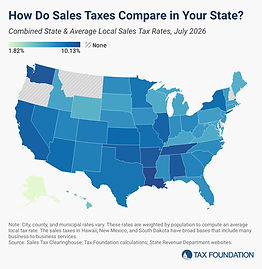
There’s a wide range of sales tax rates among the fifty states, according to a mid-July report about state and local sales tax rates by the Tax Foundation.
For example, even though the population weighted average sales tax for the 45 states that have them is 7.53%., “The five states with the highest average combined state and local sales tax rates are Louisiana (10.13 percent), Tennessee (9.61 percent), Washington (9.57 percent), Arkansas (9.48 percent), and Alabama (9.46 percent),” according to the report.
Meanwhile “The lowest non-zero state-level rate is Colorado at 2.9 percent, followed by five states at 4 percent: Alabama, Georgia, Hawaii, New York, and Wyoming.”

But unlike income taxes, which are levied on residents of individual states, people can easily cross borders to take advantage of lower rates which can be just miles away. While Tennessee has the second highest sales tax rate in the country, just across the border is Kentucky with a rate of 6 percent.
Businesses are well aware of this phenomenon, and the Tax Foundation has found that sometimes they will locate close to the borders of states with high sales-tax rates to take advantage of the additional revenues this will bring in.
“A stark example of this occurs in New England,” the report states, “where even though I-91 runs up the Vermont side of the Connecticut River, many more retail establishments choose to locate on the New Hampshire side to avoid sales taxes.”
This is hardly a hidden loophole for people in search of lower sales taxes. In fact, according to the report, “At one time, Delaware actually used its highway welcome sign to remind motorists that Delaware is the ‘Home of Tax-Free Shopping.’”
Not unusual was a 2020 listing from Loopnet, a marketing platform for commercial real estate, for development in Oak Grove, Kentucky, pointing to the “3.5% sales tax advantage of Kentucky over Tennessee (which) has resulted in Tennessee residents accounting for an overwhelming majority of Oak Grove shoppers.”
The lesson in all this is that as states (and local governments too) seek to balance their books by raising sales tax rates they “should be cautious about raising rates too high relative to their neighbors because doing so will yield less revenue than expected or, in extreme cases, revenue losses despite the higher tax rate.”
#StateandLocalManagement #StateandLocalGovernmentTaxManagement #StateSalesTaxManagement #StateSalesTaxRateVariation #StateandLocalSalesTaxPerformanceManagement #StateandLocalSalesTaxPerformance #SalesTaxBargainsAcrossBorders #SalesTaxRateDifferences #SalesTaxDifferencesAndStateBorderIssues #BorderingStatesAndSalesTaxDifferences #SalesTaxManagementAndPolicy #StateManagementEconomicDevelopment #SalesTaxBorderBattles #SalesTaxImpactOnBusinessLocation #MarketingStateSalesTaxAdvantage #TaxFoundation #TaxFoundationSalesTaxReport #StateandLocalManageentNews #StateandLocalTaxNews #BarrettandGreeneInc