
MANAGEMENT UPDATE.
MORE APPLICATIONS DON'T EQUAL MORE STAFF
In a new thought-provoking report, Work for America (WFA) details the many reasons that city, county and state governments continue to deal with problematic hiring systems even though application numbers have improved in many fields (if not all).
As one interviewee told WFA, “It’s not a volume issue. The challenge is how we move candidates through the system.”
The report explains that “Applicant interest alone does not staff government – what happens inside the hiring process determines whether that interest translates into actual hires.”
Too often, it does not.
In the current transitional environment, artificial intelligence complicates the situation by increasing application volume. It’s not only that AI has made it easier for jobseekers to find openings and apply quickly to multiple places, but also that "AI-assisted applications are increasing the number of lower-quality or less tailored submissions.”
That means more resumes, more interviews, and more decisions to be made, straining small HR staffs, which are still dependent on manual processes and limited technological solutions. As WFA reports, “teams often find systems difficult to configure, fragmented across functions or oriented toward compliance rather than performance.”
The report cites both operational and structural problems that continue to cause long delays in hiring.
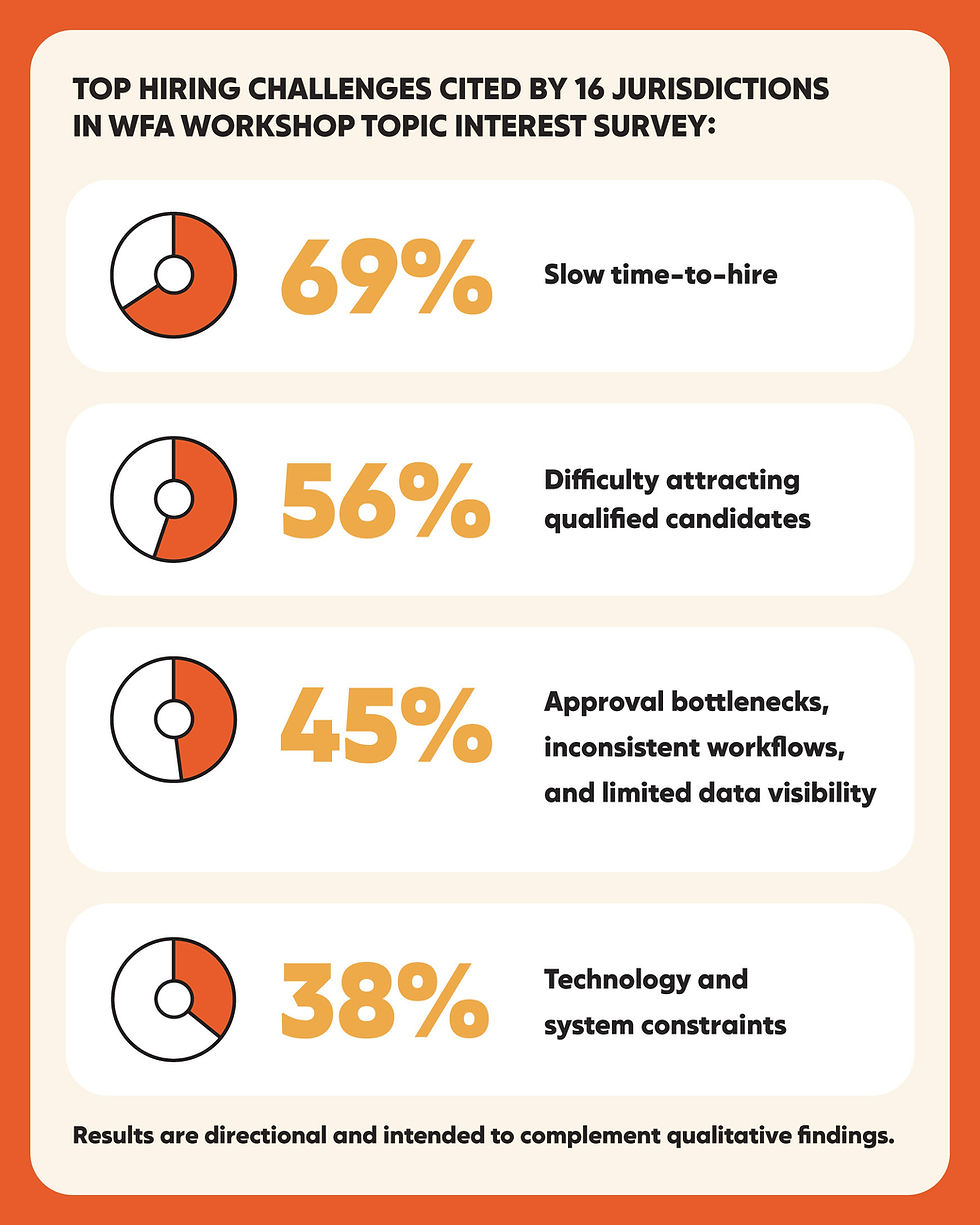
One critical issue of state and local HR management rests on the number of players involved in the hiring process, including both the central HR office, which may post job announcements or coordinate general recruitment activities, and departments that are often the ones doing interviews and making hiring decisions. Breakdowns in communication, differing schedules and multiple other competing commitments lead to bottlenecks,
“Hiring rarely breaks at a single point,” according to the report. “Instead, delays accumulate across stages, from screening to interviews to approvals, slowing momentum at each step and increasing the likelihood that candidates drop out or accept other offers.”
The report also cites four categories of structural issues that create friction in the hiring process. These include the difficulties presented by outdated hiring regulations, as well as the complications faced by individual governments due to the local economy, competition (both with other governments and the private sector), compensation constraints and limited hiring flexibility.
Although the report clearly outlines these and other challenges, it also offers steps for the future – largely focused on how governments can better work together to move toward workable solutions. As a guide to accelerating progress, the report offers four ideas for improvement.
These include:
“Shared definitions, benchmarks and performance metrics”. This includes “more consistent definitions and shared approaches to measuring each stage” of the hiring process which could “better diagnose bottlenecks, prioritize interventions, and assess whether changes are improving outcomes.”
“Structured practical peer learning”. In this section, the report notes that leaders don’t crave new solutions as much as they want to know and understand “what others changed, what constraints they faced, and what results they saw”. This includes information “focused on implementation details”
“Guidance and Shared Frameworks for Modernizing Hiring Systems”. While the potential of artificial intelligence is introduced, the focus is not so much on getting access to new tools, but on guidance as to how to use them and “how to integrate new technologies into existing hiring systems while maintaining fairness, compliance and public trust.”
“Field-level capacity for implementation support.” To put ideas for improvement and recommendations into practices, the report builds a case for more field-level support to governments “through intermediaries, technical assistance providers, or shared service models (that) could help more governments move from diagnosis to execution.”
#StateandLocalManagement #StateandLocalPerformance #StateandLocalHiringPerformance #StateandLocalGovernmentHumanResources #StateandLocalGovernmentHR #StateandLocalHR #StateandLocalHiring #CityHiring #CountyHiring #StateandLocalJobApplications #CityJobApplications #CountyJobApplications #StateandLocalHiringConstraints #ModernizingStateandLocalHiring #StateandLocalPerformanceMeasurementForHiring #StateandLocalHiringData #WokForAmerica #WorkForAmericaHiringReport #ArtificialIntelligenceAndStateLocalHiring #StateandLocalHiringFragmentation #StateandLocalManagementNews #StateandLocalHumanResourcesNews #StateandLocalHiringNews #BarrettandGreeneInc


